





How to Choose a Non-Clogging Submersible Sewage Pump for Wastewater Applications?
Release time: 2026-10-04
Table of Contents
Choosing a sewage pump is not simply a matter of finding a model with the highest flow rate or the lowest price. Wastewater can contain suspended solids, fibers, sludge, and other materials that make pumping more demanding than handling clean water. If the pump is not matched to the actual working conditions, clogging, unstable flow, and frequent maintenance can become costly problems. This is why pump selection should start with the wastewater itself and the way it needs to be moved.
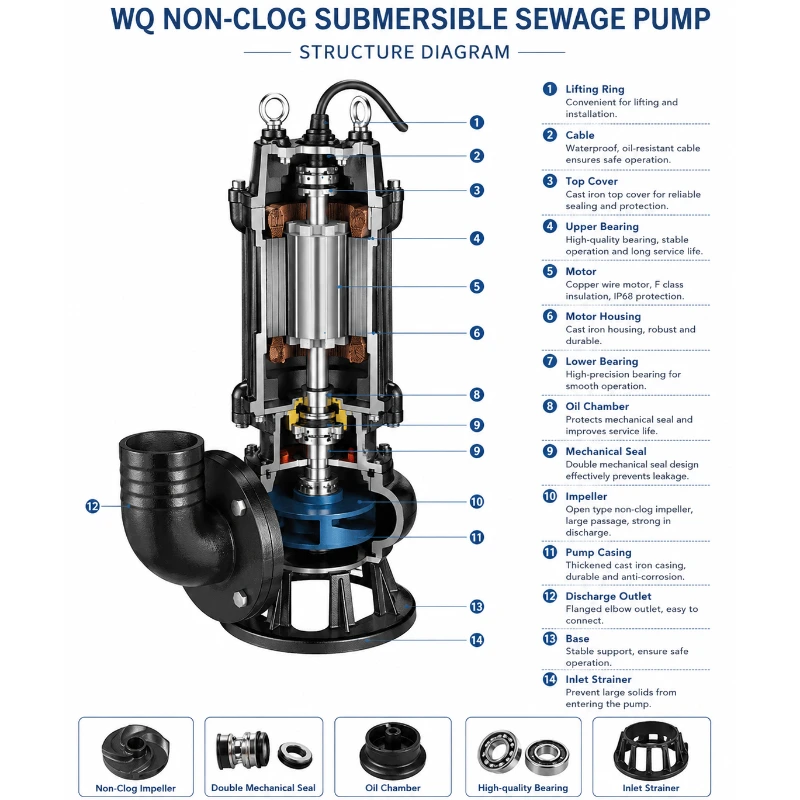
For many municipal, industrial, and drainage applications, a non-clogging sewage pump can be a practical choice when the wastewater contains solids or materials that may interfere with normal pumping. However, “non-clogging” should not be treated as a guarantee that a pump can handle every type of waste. Flow, head, solids, installation conditions, and operating requirements still need to be considered together. A good selection process is about finding the right balance between pump design and the actual application.
Start with the Wastewater Characteristics
Before comparing pump models, take a close look at the wastewater being handled. Clean drainage water, domestic sewage, industrial wastewater, and high-solids wastewater can place very different demands on a pump. The size and type of solids are particularly important because fibrous materials, rags, sludge, and larger suspended particles can create problems for equipment that is not designed for this type of service.
This is where a non-clogging design becomes relevant. A pump intended for wastewater applications should be selected according to the characteristics of the medium rather than simply its general name. Consider whether the liquid contains solids, how frequently the pump will operate, and whether the system is expected to run continuously or intermittently. These details help narrow down the suitable pump type before comparing individual specifications.
Match Flow Rate to the Actual Demand
Flow rate is one of the first technical specifications buyers usually look at, but choosing the largest available capacity is rarely the best approach. The required flow depends on how much wastewater needs to be transferred within a specific period and how the overall system is designed.
For example, a drainage system serving a small facility may have very different requirements from a municipal wastewater installation. Oversizing a pump can increase energy consumption and may cause the pump to operate away from its most suitable working point. Undersizing, on the other hand, can result in insufficient drainage capacity and longer operating periods.
When comparing a non-clogging submersible pump, buyers should identify the required duty flow first and then compare available models against that requirement. PumpsHKZQ offers WQ-series options covering a broad range of applications, with listed flow capacities from 6 to 800 m³/h. The appropriate model still depends on the actual system conditions rather than the maximum range alone.
Do Not Overlook Pump Head
Flow rate tells you how much wastewater needs to be moved, while pump head helps determine whether the pump can move it through the required system. This includes vertical lifting as well as resistance created by pipes, bends, valves, and other components.
A pump with a high flow rating may still be unsuitable if its available head does not match the system. This is one reason wastewater pump selection should consider flow and head together instead of treating them as separate specifications.
The WQ-series range available from PumpsHKZQ includes listed head capacities from 14 to 80 meters. This provides different options for applications with varying lifting and transportation requirements. Before choosing a model, buyers should calculate the actual system head and compare it with the pump’s operating range. Getting this step right can have a direct effect on pumping performance and overall operating efficiency.
Consider Solids Handling and Clogging Risk
Solid handling is often one of the most important considerations when selecting a pump for wastewater. Unlike clean water, sewage can carry materials that are difficult to move through conventional pumping equipment. Fibers and other debris may become caught in the hydraulic passage, while accumulated solids can affect normal operation.
A suitable pump should therefore be selected according to the expected solids content and the characteristics of the wastewater. This does not mean that a non-clogging pump can eliminate every possible blockage. Instead, the purpose of a suitable non-clogging design is to reduce the risk of problems under the conditions for which the pump is intended.
For buyers, it is useful to ask practical questions before ordering: What type of solids are present? How large are they? Is the wastewater relatively consistent, or does its composition change frequently? These answers provide much more useful information for pump selection than simply looking at motor power or price.
Where Can a Non-Clogging Submersible Pump Be Used?
A non-clogging submersible pump can be considered for a variety of wastewater and drainage applications where the equipment needs to handle contaminated water containing suspended materials. Municipal wastewater systems, sewage treatment facilities, industrial drainage, and other wastewater transfer applications can have different requirements, but they share the need for reliable fluid transportation.
The application itself should still determine the final specification. Industrial wastewater, for instance, may require closer attention to the characteristics of the liquid, while municipal sewage systems may place greater emphasis on continuous operation and solids handling. Installation depth, discharge pipe arrangement, operating frequency, and available power supply should also be checked before selecting a model.
For systems that specifically require a submersible sewage pump for wastewater, the same principle applies: the pump should be selected according to the actual flow, head, solids content, installation conditions, and operating environment rather than the product name alone.
How to Select the Right Pump for Your System
A practical selection process can be kept relatively simple. Start by identifying the wastewater characteristics and the expected solids content. Next, determine the required flow rate and total head based on the actual system. After that, check installation conditions, operating frequency, power requirements, and any special requirements related to the application.
Once these factors are clear, it becomes much easier to compare pump models. The goal is not necessarily to choose the biggest or most powerful pump, but to select one that can operate reliably within the required working range.
For B2B buyers, this approach can also make communication with a supplier more efficient. Instead of sending only a request for a sewage pump, providing information such as required flow, head, wastewater type, solids characteristics, installation conditions, and operating schedule gives the supplier a much clearer basis for recommending a suitable configuration.
PumpsHKZQ Non-Clogging Submersible Sewage Pump
For customers looking for a pump for wastewater transfer, the PumpsHKZQ Non-Clogging Submersible Sewage Pump provides an option within the WQ-series range. Its listed flow range covers 6–800 m³/h, while the listed head range is 14–80 m. This range allows different models to be considered for applications with different hydraulic requirements.
The product is intended for wastewater and sewage pumping situations where handling contaminated water and reducing clogging-related problems are important considerations. However, the final model should always be selected according to the actual flow, head, wastewater characteristics, and installation conditions.
For buyers who are unsure which specification fits their system, PumpsHKZQ can be contacted with the project requirements for further selection assistance. Providing the operating conditions in advance can help narrow down the appropriate pump more efficiently and avoid selecting a model based only on a single catalog specification.
FAQ
What is a non-clogging sewage pump used for?
It is designed for wastewater and sewage applications where the pumped liquid may contain solids, fibers, or other materials that can increase the risk of clogging.
How do I choose the right sewage pump flow rate?
Start with the amount of wastewater that needs to be transferred within a specific period, then match the required flow with the pump’s operating range and system conditions.
Why is pump head important for wastewater applications?
Pump head determines whether the pump can move wastewater through the required vertical lift and piping resistance. It should be considered together with flow rate.
Can a non-clogging pump handle all types of wastewater?
No pump should be assumed to handle every type of wastewater. The wastewater characteristics, solids content, flow, head, and installation conditions should all be checked before selection.