





Why Are Stainless Steel Multistage Centrifugal Pumps Used in Industrial Water Supply?
Release time: 2026-11-23
Table of Contents
Industrial water supply systems often need to do more than simply move water from one point to another. Manufacturing facilities, processing plants, boiler systems, and cooling networks may require a steady flow at a specific pressure, sometimes over long operating hours. In these applications, pump selection affects not only water delivery but also energy use, maintenance needs, and the reliability of production equipment.
A stainless steel multistage centrifugal pump is a practical option for many industrial water applications because it combines a compact structure with the ability to generate relatively high pressure. Multiple impellers work in sequence to increase the pressure of the liquid as it passes through the pump. Stainless steel wetted components can also provide better corrosion resistance than ordinary cast iron in suitable operating conditions. For industrial buyers, understanding the pump structure, material options, and operating requirements is essential before choosing a model.
What Makes Industrial Water Supply Different from Ordinary Water Transfer?
Industrial water supply is often more demanding than basic water transfer. A factory may need water for equipment cooling, production processes, boiler feed, cleaning, or circulation. Each application has different requirements for flow rate, pressure, temperature, and liquid quality. Some systems operate continuously, while others experience significant changes in demand during different production stages.
These conditions make pump selection an important part of system planning. A pump that provides sufficient flow but cannot meet the required head may fail to deliver water to the intended equipment. On the other hand, selecting a pump with excessive capacity can increase energy consumption and create unnecessary pressure in the pipeline. The goal is to match the pump’s operating point with the actual system requirements.
An industrial water supply pump should therefore be evaluated according to the complete application rather than motor power alone. Flow rate, total head, pipeline resistance, liquid properties, and operating hours all influence the final selection. This is one reason multistage centrifugal pumps are commonly considered for industrial systems that require stable water delivery at relatively high pressure.
How Does a Vertical Multistage Centrifugal Pump Generate Pressure?
A vertical multistage centrifugal pump uses several impellers arranged in sequence along the pump shaft. As water enters the first stage, the rotating impeller transfers energy to the liquid. The flow then passes through guide vanes into the next stage, where additional energy is added. This process continues through the pump, allowing the unit to develop a higher total head than a comparable single-stage design.
The vertical arrangement also offers practical installation benefits. The motor is positioned above the hydraulic section, while the impellers and guide components are stacked below it. This compact layout can help save floor space in equipment rooms and industrial facilities where installation space is limited.
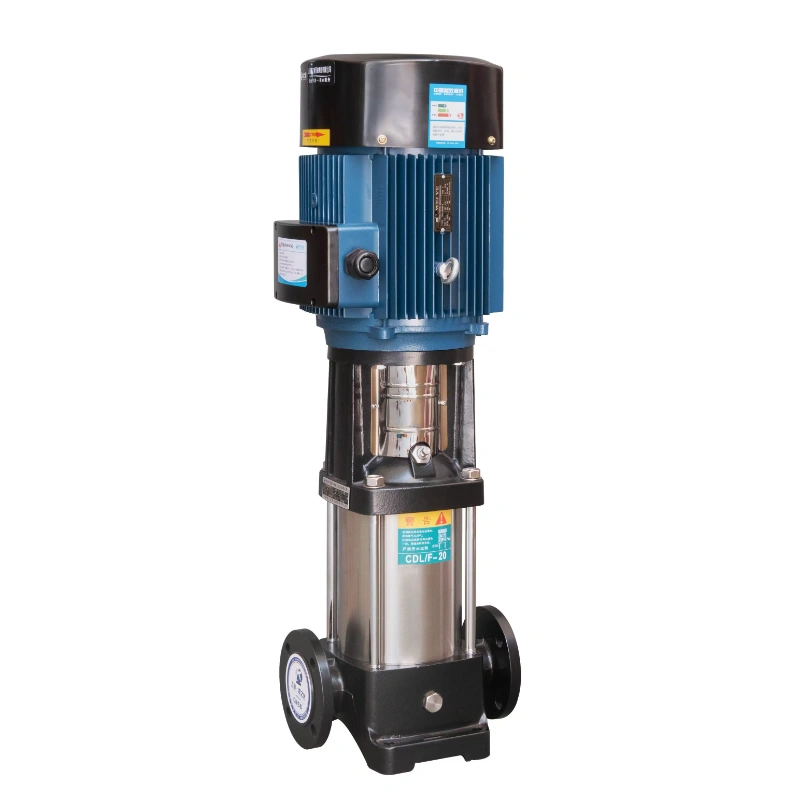
The CDL vertical centrifugal pump follows this general design. Its motor shaft connects to the pump shaft through a coupling, while tie rods secure the pressure-resistant cylinder and internal flow components. The inlet and outlet are positioned along the same horizontal axis at the bottom of the pump, making the design suitable for inline pipeline installation. This structure supports pressure boosting and fluid circulation in a range of industrial applications.
Why Is Stainless Steel Important for Industrial Pump Applications?
Pump material has a direct impact on service life and compatibility with the liquid being transferred. Industrial water may contain dissolved minerals, treatment chemicals, or other substances that can affect metal components over time. If the wetted parts are not suitable for the medium, corrosion may lead to leakage, reduced performance, or more frequent maintenance.
Stainless steel is valued for its corrosion resistance and suitability for many clean-water and selected industrial liquid applications. In the CDLF model, the wetted components are made from 304 stainless steel. This makes it a suitable option for applications such as clean water transfer, softened water supply, boiler feed water, and certain mildly corrosive liquids, provided the operating conditions are compatible with the material.
However, stainless steel should not be treated as universally resistant to every chemical. Its performance depends on the liquid’s composition, concentration, temperature, and other operating conditions. For liquids containing aggressive chemicals or high chloride concentrations, buyers should confirm material compatibility before ordering. Choosing the correct material helps reduce corrosion risks and supports more reliable long-term operation.
CDL vs. CDLF Pump: What Are the Main Differences?
Although CDL and CDLF pumps share a similar vertical multistage structure, their material configurations differ. The CDL model uses a cast iron pump housing, while the CDLF model features stainless steel wetted components. This distinction is important when selecting a pump for different water qualities and industrial environments.
| Comparison | CDL Pump | CDLF Pump |
|---|---|---|
| Pump structure | Vertical multistage | Vertical multistage |
| Main material feature | Cast iron housing | Stainless steel wetted parts |
| Typical application | General clean water transfer | Clean water and suitable mildly corrosive liquids |
| Key consideration | General operating conditions | Liquid and material compatibility |
The choice between the two should depend on the actual medium and operating environment, not simply on the assumption that one model is always better. For general clean-water applications, a CDL model may meet the requirements. Where improved corrosion resistance is needed, a CDLF pump with stainless steel wetted parts may be more appropriate.
Both models should be selected according to the required flow, head, temperature, and installation conditions. Checking these factors before purchase helps avoid choosing a pump that is either undersized or unnecessarily powerful.
Which Industrial Applications Benefit from Stainless Steel Multistage Pumps?
Vertical multistage pumps are used in a variety of industrial water systems. In manufacturing facilities, they can support general water supply and pressure boosting for production equipment. Their multistage design is useful where water needs to be delivered at a higher pressure through pipelines or to equipment located at a different elevation.
They can also be used in boiler feed water and softened water applications when the pump’s rated pressure, temperature, and material specifications match the system requirements. In cooling and circulation networks, the pump helps move water through equipment and pipeline loops. Water treatment facilities may also use these pumps to transfer treated water between different process stages.
The product’s stated medium temperature range is -15°C to +120°C, making it suitable for a range of temperature conditions within its specified operating limits. Still, the actual application must be checked against the allowable pressure-temperature curve and the selected model’s performance data. Pump suitability depends on the complete operating point, not just the general application category.
What Should You Consider When Selecting an Industrial Water Supply Pump?
Before selecting a pump, start with the required flow rate and total head. Flow rate represents the amount of liquid the system needs to move over a given period, while head indicates the energy required to overcome elevation differences and pipeline resistance. These two values help determine the appropriate pump model and operating point.
Material compatibility is equally important. Consider whether the liquid is clean water, softened water, boiler feed water, or a mildly corrosive industrial medium. Temperature, concentration, and chemical composition should all be checked before deciding whether stainless steel wetted components are suitable. Motor power, available installation space, connection size, and expected operating hours should also be included in the evaluation.
The PumpsHKZQ CDL/CDLF series lists a rated flow range of 2–150 m³/h, a pressure range of 16–23 bar, and motor power from 0.37 to 75 kW. Its stated medium temperature range is -15°C to +120°C, with a maximum ambient temperature of +40°C. These are product range specifications; the actual flow and head available depend on the selected model. Buyers should consult the performance curve and confirm the duty point before finalizing a configuration.
Why Consider PumpsHKZQ CDL/CDLF Vertical Multistage Pumps?
PumpsHKZQ offers CDL and CDLF vertical multistage centrifugal pump options for different industrial water transfer and pressure boosting requirements. The series features a compact vertical layout, with the motor installed above the pump and the hydraulic stages arranged below. Its inline inlet and outlet design can simplify integration into compatible pipeline systems and help reduce installation space.
The pump uses a mechanical seal with a silicon carbide interface and a fluoro-rubber secondary seal, according to the product information. An intelligent protector can also be fitted as required to provide protection against conditions such as dry running, phase loss, and overload. These features can support reliable operation when the pump is correctly selected and installed.
For industrial buyers, the most important step is matching the pump to the actual application. Reviewing the required flow, head, liquid properties, temperature, and installation conditions helps determine whether CDL or CDLF is the appropriate choice. You can explore the CDL / CDLF Stainless Steel Vertical Centrifugal Pump from PumpsHKZQ for further product information and model selection.
FAQ
What kinds of liquids are suitable for CDL/CDLF pumps?
According to the product specifications, these pumps can be used for clean water, softened water, boiler feed water, and selected mildly corrosive industrial liquids. The stated medium temperature range is -15°C to +120°C. Actual suitability depends on the liquid composition, concentration, temperature, and material compatibility.
What is the benefit of the inline inlet and outlet design?
The inlet and outlet are positioned on the same horizontal axis, allowing the pump to be installed directly in a compatible pipeline. This arrangement can reduce installation space and make maintenance more convenient. Whether pipeline modification is needed depends on the existing pipe layout and connection dimensions.
How durable is the standard mechanical seal? Can it be upgraded?
The product uses a silicon carbide mechanical seal interface, which offers good wear resistance and temperature performance. Fluoro-rubber sealing components are also specified. Seal selection should be based on the liquid properties and operating conditions. For media containing sediment or corrosive substances, confirm the appropriate seal configuration with the supplier before use.
How do I choose between CDL and CDLF pumps?
The main difference is their material configuration. CDL uses a cast iron pump housing, while CDLF has stainless steel wetted parts. Consider the liquid being transferred, corrosion risk, temperature, required flow, and head before selecting a model.