





How Does an Intelligent Constant Pressure Water Supply System Improve Water Distribution in High-Rise Buildings?
Release time: 2026-11-13
Table of Contents
Water pressure problems are common in high-rise buildings, especially when residents use water at the same time. People living on upper floors may experience weak water flow, while lower floors can sometimes face excessive pressure. These issues are not simply inconvenient; they can also affect plumbing performance, water supply reliability, and the overall comfort of building occupants. As buildings become taller and water demand becomes more variable, traditional water supply methods may struggle to maintain consistent pressure throughout the day.
An intelligent constant pressure water supply system offers a more flexible approach. By combining booster pumps, pressure sensors, variable frequency control, and pressure stabilizing components, it adjusts pump operation according to actual water demand. Instead of running at a fixed speed, the equipment responds to changes in pipeline pressure and helps maintain a more stable water supply. For residential and commercial buildings, this means better pressure management, more reliable operation, and improved control over water distribution.
Why Is Water Pressure Unstable in High-Rise Buildings?
Water pressure in a high-rise building is affected by several factors, and building height is one of the most important. Water needs sufficient pressure to travel from the supply point to upper floors. As the vertical distance increases, more pressure is required to deliver water to taps, showers, and other outlets. Without an appropriately designed booster system, upper floors may receive insufficient water pressure, particularly during periods of heavy use.
Water demand also changes throughout the day. In residential buildings, morning and evening are usually busy periods when many households use showers, washing machines, and kitchen appliances at the same time. In commercial buildings, demand may rise during working hours or scheduled cleaning periods. These fluctuations affect pipeline pressure and can cause inconsistent water flow.
Pipe length, diameter, fittings, valves, and internal friction also influence pressure loss. If a system is not properly selected for the building’s actual flow and pressure requirements, some floors may experience weak water supply while others receive more pressure than necessary. A suitable constant pressure water pump arrangement helps respond to these changing conditions and supports more balanced water distribution.
Why Can Traditional Water Supply Methods Struggle with Changing Demand?
Traditional water supply arrangements may rely on fixed-speed pumps or manual adjustments. While these methods can work under relatively stable conditions, they are less flexible when water consumption changes frequently. If a pump operates at a constant speed, it may continue delivering water at a similar output even when demand drops. During peak periods, however, its capacity may not be sufficient to maintain the required pressure across the building.
This mismatch can lead to several operational problems. Low pressure may affect water availability on upper floors, while excessive pressure in certain sections can increase stress on pipes, joints, and valves. Frequent pump starting and stopping can also contribute to equipment wear, especially when the system has limited pressure buffering capacity.
For building operators, the challenge is not simply to install a more powerful pump. The water supply system needs to respond to real demand while keeping pressure within an appropriate operating range. Variable frequency control provides a practical way to achieve this. By adjusting pump speed instead of relying only on fixed output, the system can better match water delivery to current consumption.
How Does an Intelligent Constant Pressure Water Supply System Work?
An intelligent constant pressure water supply system uses pressure monitoring and automatic control to regulate pump operation. Pressure sensors detect changes in the pipeline, and the control cabinet processes this information against the target pressure setting. When water consumption increases and pipeline pressure begins to fall, the variable frequency controller increases pump speed to provide additional water. When demand decreases, it reduces the pump speed to avoid unnecessary output.
The pressure stabilizing tank plays another important role. It stores a certain amount of pressurized water and helps buffer short-term pressure fluctuations. For example, when several outlets are opened or closed within a short period, the tank can reduce sudden changes in pipeline pressure. It also helps limit unnecessary pump starts and stops, supporting smoother operation.
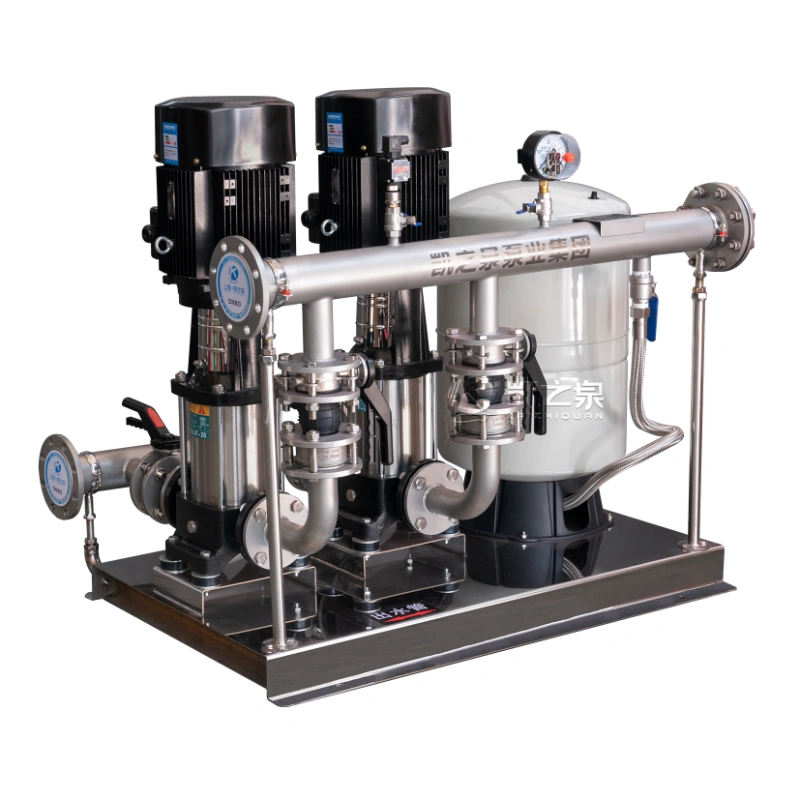
In the Intelligent Constant Pressure Water Supply Equipment offered by PumpsHKZQ, the integrated arrangement combines booster pumps, an inlet collecting main, an outlet pressure stabilizing pipeline, valve assemblies, and a pressure stabilizing tank. The equipment is designed to connect directly to the municipal water supply pipeline without creating negative pressure in the municipal network. Its variable frequency control technology adjusts pump operation according to pipeline conditions, helping maintain a stable supply as water demand changes.
Why Are Vertical Multistage Pumps Used in Building Water Supply?
The pump configuration is an important part of a building’s water supply design. Vertical multistage pumps are commonly used in booster applications because their multistage structure can provide the head needed to move water through buildings and other distribution networks. The required pump capacity depends on factors such as building height, expected water consumption, pipeline resistance, and the pressure needed at the highest or most demanding outlet.
The equipment uses two vertical multistage pumps arranged in a one-working, one-standby configuration. During normal operation, one pump supplies water while the other remains available as a backup. If the operating pump fails or requires maintenance, the standby pump can take over automatically, helping reduce the risk of an unexpected water interruption. This arrangement is particularly useful in residential and commercial buildings where continuous water availability matters.
When selecting a vertical centrifugal pump for a booster system, building operators should look beyond the motor power alone. Flow rate, rated head, connection size, operating conditions, and the required duty point all need to be considered together. Correct pump selection helps the system meet actual demand without relying on excessive pressure or unnecessarily large equipment.
How Does Intelligent Control Improve Energy Efficiency and Maintenance?
One advantage of variable frequency control is that pump output can be adjusted to match water consumption. During low-demand periods, the system can reduce pump speed rather than continuously operating at full capacity. When demand rises, it increases output as needed. This approach can help reduce unnecessary energy consumption compared with a fixed-speed arrangement that does not respond effectively to changing demand. Actual energy savings depend on the pump selection, operating schedule, system design, and usage conditions.
The product also integrates intelligent control with cloud-based monitoring. According to the product specifications, the equipment can connect with a control center, alarm system, mobile terminals, and cloud platform through dedicated 5G VPN communication. This allows relevant personnel to monitor operating conditions and receive equipment alerts remotely, making it easier to identify abnormal conditions and coordinate maintenance.
For property managers, this type of monitoring can make daily operation more manageable. Instead of relying entirely on on-site inspections, maintenance teams can use available operating information to understand equipment status and respond to potential issues. Reliable monitoring does not replace regular inspection, but it can support more timely maintenance and better operational oversight.
What Should You Consider When Choosing a Constant Pressure Water Supply System?
Choosing equipment for a high-rise building starts with understanding the building’s actual water demand. The expected peak flow rate, required outlet pressure, number of floors, occupancy, and distribution layout all influence the selection. A system designed for a small residential building may not be suitable for a large commercial property, even if both applications require constant-pressure water supply.
It is also important to check the equipment’s operating range and pump configuration. The PumpsHKZQ equipment lists a flow range of 0–84 m³/h, a pressure range of 0–2.5 MPa, and a regulation accuracy of 0.01 MPa. Its listed power supply is 380V ±10%, 50Hz ±5%, with motor capacity up to 37 kW. These specifications provide a reference for preliminary evaluation, but the final model and operating settings should be selected according to the project’s calculated flow and head requirements.
The product’s performance table includes CDLF2 models with a rated flow of 2 m³/h and different rated heads, ranging from 15 m to 82 m. This illustrates why model selection matters: the appropriate pump should match the required operating point rather than simply choosing the highest available head. Building designers and equipment suppliers should review the application conditions together before confirming a configuration.
FAQ
What is the function of the pressure tank in a constant pressure water supply system?
The pressure stabilizing tank stores pressurized water and buffers sudden changes in pipeline pressure. It helps maintain more stable outlet pressure during short periods of changing water demand and reduces frequent pump starting and stopping. This can support smoother operation and help limit unnecessary equipment wear.
Why does this equipment use two vertical pumps, with one working and one on standby?
The dual-pump configuration helps maintain water supply continuity. If the operating pump fails or requires maintenance, the standby pump can automatically take over, reducing the risk of water interruption. This arrangement is useful for residential and commercial buildings where a reliable water supply is important.
Can the output water pressure be adjusted?
Yes. The variable frequency control system allows users to set a target pressure within the equipment’s specified pressure range of 0–2.5 MPa. The controller adjusts pump speed according to changes in water demand to help maintain stable outlet pressure. The actual target setting should be determined by the building’s height, pipeline resistance, and end-use pressure requirements.